
11
2025
-
12
Selection of plastic cable ties for logistics packaging specifications
Author:
Specifications for Plastic Strapping in Logistics Packaging
Material Types and Performance Characteristics
Plastic strapping for logistics packaging is primarily manufactured from polypropylene (PP), polyester (PET), and nylon, each offering distinct advantages. PP strapping is lightweight, cost-effective, and resistant to moisture and chemicals, making it ideal for bundling lightweight goods in humid or high-temperature environments. It is commonly used for sealing corrugated boxes, securing palletized loads, and bundling compressed materials like textiles.
PET strapping, known for its high tensile strength and shock resistance, is a durable alternative to steel strapping for heavy-duty applications. It maintains stability under compression, resists elongation, and performs reliably in extreme temperatures (-110°C to 120°C). Its flexibility reduces the risk of cargo shifting during transit, while its non-corrosive nature prevents rust-related damage.
Nylon strapping combines elasticity with high tensile strength, offering superior impact absorption and fatigue resistance. It is suitable for securing goods prone to settling, such as stacked coils or irregularly shaped items, as it maintains tension without loosening.
Dimensional Specifications for Load Stability
The width and thickness of plastic strapping directly influence its load-bearing capacity. For lightweight packages (e.g., retail goods or small boxes), strapping widths of 12–15mm with thicknesses of 0.5–0.7mm provide sufficient strength while minimizing material waste. Medium-duty applications, such as palletized loads or industrial equipment, require strapping widths of 16–19mm and thicknesses of 0.8–1.0mm to withstand higher tension forces.
Heavy-duty strapping for securing steel coils, lumber, or machinery typically features widths exceeding 19mm and thicknesses of 1.0–1.2mm. These dimensions ensure compliance with international standards for load security, such as the requirement that strapping must resist breaking under forces equivalent to 2.5 times the weight of the packaged goods.
Length considerations depend on the bundling method. Continuous rolls (e.g., 1,000m per roll) are cost-effective for automated packaging lines, while pre-cut lengths (e.g., 200–500mm) simplify manual applications. Proper tensioning is critical; over-tightening may deform fragile items, while insufficient tension risks load instability.
Environmental Adaptability and Safety Standards
Plastic strapping must perform reliably across diverse environmental conditions. UV-stabilized variants resist degradation from prolonged sun exposure, making them suitable for outdoor storage or transportation. In cold climates, low-temperature-resistant strapping (e.g., rated to -40°C) prevents embrittlement, ensuring secure fastening in refrigerated warehouses or polar regions.
Flame-retardant strapping, compliant with standards like UL 94V-2, self-extinguishes within seconds of ignition, reducing fire hazards in enclosed spaces such as shipping containers or aircraft cargo holds. Non-conductive properties are essential for electrical equipment packaging, preventing short circuits during transit.
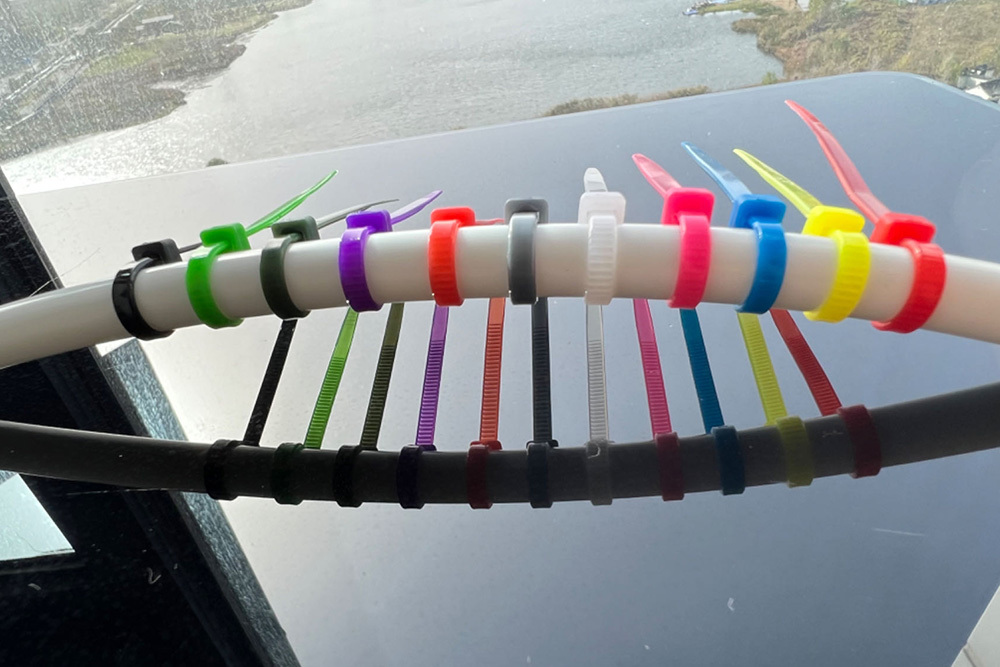
Safety features like rounded edges minimize abrasion risks during handling, while tamper-evident designs with breakable seals deter unauthorized access. Color-coding systems enhance operational efficiency by visually distinguishing strapping types (e.g., red for high-risk loads, green for eco-friendly materials). These specifications collectively ensure plastic strapping meets global logistics requirements for durability, safety, and environmental resilience.
plastic cable ties
Hot News
2025-12-11
Selection of plastic cable ties for logistics packaging specifications
Plastic strapping for logistics packaging is primarily manufactured from polypropylene (PP), polyester (PET), and nylon, each offering distinct advantages. PP strapping is lightweight, cost-effective, and resistant to moisture and chemicals, making it ideal for bundling lightweight goods in humid or high-temperature environments. It is commonly used for sealing corrugated boxes, securing palletized loads, and bundling compressed materials like textiles.
2025-12-11
Specification parameters of architectural decoration plastic cable ties
Architectural decoration projects require plastic cable ties that balance strength and flexibility. Standard width options range from 2.5mm to 8mm, with narrower ties (2.5–4mm) suitable for lightweight tasks like securing decorative trim or organizing small wire bundles. Medium-width ties (5–6mm) are ideal for mid-sized applications, such as fastening cable trays or mounting lighting fixtures.
2025-12-10
Safety specifications for plastic cable ties for children's products
Children’s products demand materials that withstand physical stress and environmental exposure without compromising safety. Nylon 66 (PA66) is widely adopted due to its non-toxic composition, meeting UL 94V-2 flame-retardant standards to prevent fire hazards. This material resists temperatures from -40°C to 85°C, ensuring stability in varying climates, such as outdoor playgrounds or heated indoor spaces.
2025-12-10
Selection of plastic cable ties for new energy high-voltage lines
High-voltage cables in renewable energy installations, such as solar farms or wind turbines, generate electromagnetic fields and heat, requiring materials that resist degradation. Nylon 66 (PA66) reinforced with glass fibers is a common choice due to its high tensile strength (up to 70kg) and thermal stability, withstanding temperatures from -50°C to 120°C. This material’s low electrical conductivity minimizes energy loss and prevents short circuits, critical for maintaining system efficiency.